Video creation is all about telling a story. This is where it begins. A thought, a memory, an imagination. Even the shortest reel must have a purpose.
Studiobinder.com has several suggestions on how to brainstorm ideas. One is to start with the ending first. If you have the end goal in mind,
it might help to flesh out the other parts.
Another way to approach storytelling is write about what you know. Most everyone has a background. Something memorable that happened to them or someone they know. This helps with location as well.
You could film in your own backyard or a college campus.
StoryBoards
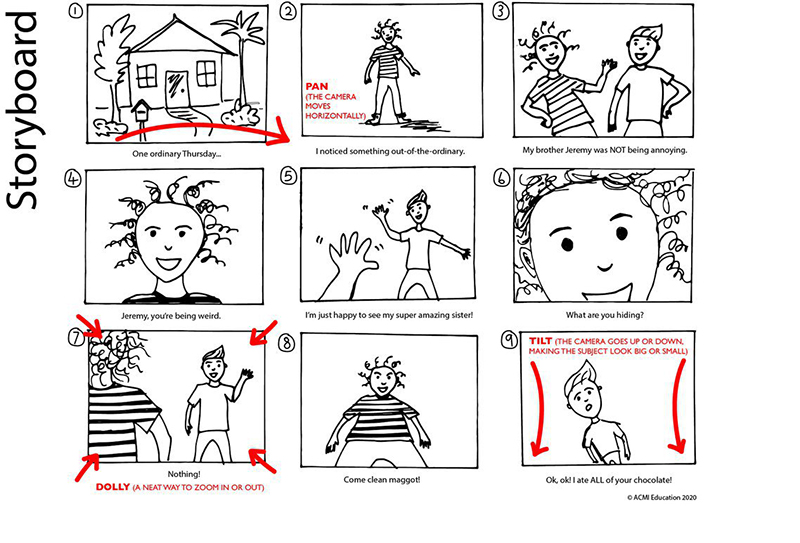
Once you have your story written it is important to map it out. This is essential whether creating a small film or a full scale production. Storyboards not only help visualize your story,
they streamline your shooting schedule. They will showcase what shots you need to take so you are know exactly what your shooting day will look like in terms of what shots you will take.
Image from ACMI.
Different types of Shots
Long shots which show the entire scene.
Medium shots start at the waist up
Close up shots focus on the face or object
Establishing shots help to put the location in context. Describes where you are through a visual lens.
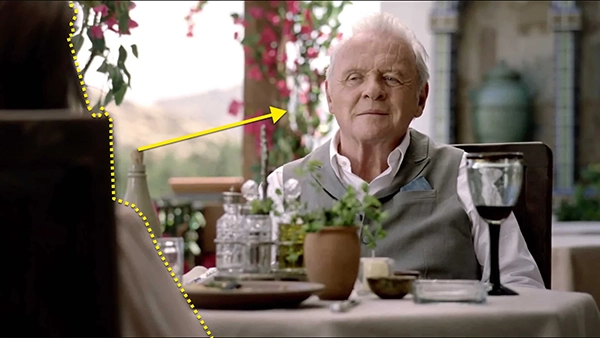
Over-the-shoulder shots are used in the interview process. It frames the shot from the prespective of another person. The camera is positioned behind and slighlty to the side of one actor with the other actor
in the background. Image from Pixflow
Shooting
You are now ready to start shooting (assuming all actors and props are in place, that is outside of the scope of this project). Taking the script and storyboard, you will travel to the location of your movie set. This could actually
be a stage set up or an outside location. This will all be mapped out ahead of time.
Take plenty of B and C roll along with your main shots. B-roll is the secondary shots that give you context. It supports the main story. Such as the lamp in the dark room. Or the dagger in someone’s hand. It also helps hide bad jump cuts and adds interest to your storytelling. Without adequate B roll it can be a challenge to really tell your story.
C-roll is used less often and only when you don’t have enough main footage or B-Roll runs out. C-roll might consist of ocean waves or clouds, it is more or less used as a filler.
After the Shoot
Once you have all your shots planned out, you are ready to start editing it. We will go over those steps in the editing section.