Usability testing shows how people actually behave with your product. While analytics tell you what people do, testing explains why they do it. Observing users complete tasks uncovers mismatches between your design’s intentions and user expectations. These mismatches range from small copy issues to serious accessibility barriers.
Some Typical Testing Methods and When to Use Them
Each usability testing method balances time, depth, and scalability differently. Some are best for early discovery, while others refine existing designs or confirm performance. Start with smaller, faster methods to uncover key insights, then iterate and expand as your design matures.
Hallway or guerrilla testing: Quick and inexpensive. Ask 5 to 8 people to try core tasks. Use this early to catch obvious problems.
Think-aloud testing: Ask participants to say what they are thinking while they work. This exposes confusing labels and hidden assumptions.
Task-based testing: Give participants realistic goals and measure success, time on task, and error patterns.
Moderated testing: The moderator can probe and clarify in real time. Can be done remotely as well, useful when participants are in different locations.
Accessibility evaluation: Assess how well your design supports users with disabilities using screen readers, keyboard navigation, and contrast tests.
A/B testing: Use when you want to compare two versions and measure a specific metric, such as task completion or conversion rate.
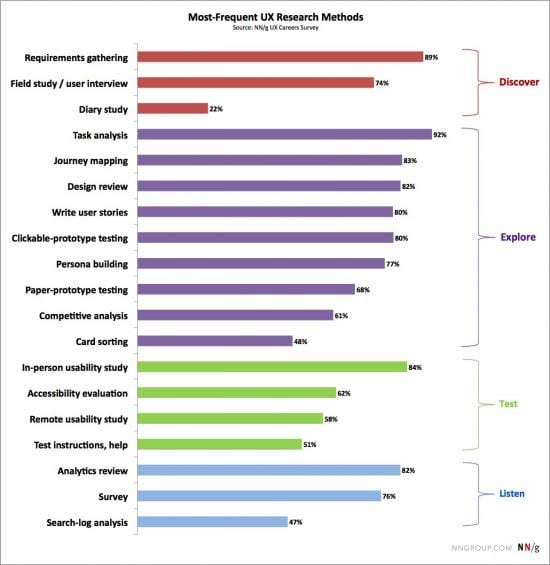
Figure: “Most-Frequent UX Research Methods,” a chart from the Nielsen Norman Group showing how often many different UX research methods are used across four project stages.
Running Research: The Process
Design Good Tasks
Write tasks that reflect real user goals. Avoid phrasing that reveals the answer. For example, instead of “Find the contact form,” use “You need to report a billing error. Where would you go to submit that request?” Tasks like this reveal realistic navigation and comprehension issues.
Recruit Participants Ethically
Diversity matters. If you only test tech-savvy colleagues, you will miss real-world problems. Recruit participants who reflect the range of devices, abilities, ages, and languages of your audience. Compensate participants for their time, obtain informed consent, and explain the purpose of the test.
Turn Test Result Into Action
Capture video and notes, then cluster observations into themes. Prioritize fixes that increase success on core tasks, reduce errors, or improve comprehension. Small fixes often have outsized effects: clearer labels, visible feedback on actions, and logical task flows are common winners.
Usability testing gives you evidence you can act on. The quickest path to meaningful improvement is to test with real users, document what you see, and make targeted changes.